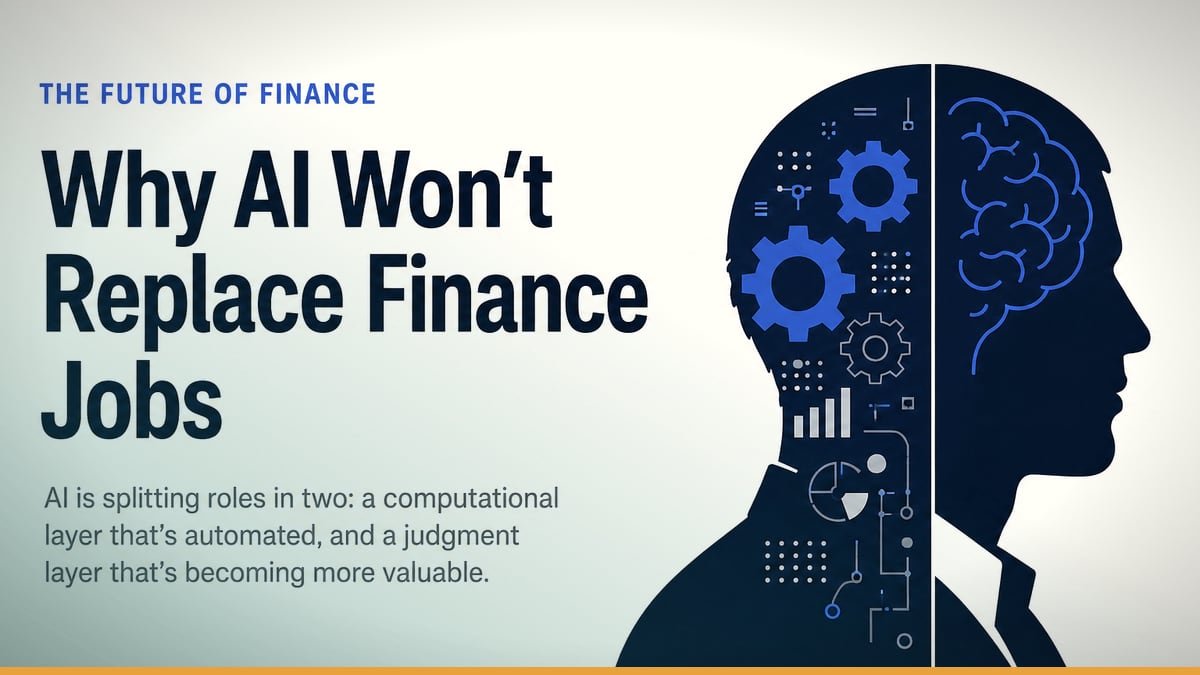
Header image source: AI Won’t Replace Finance Jobs — But It Will Split Them in Two via AI in Finance – Substack via Google — cropped to 16:9 and colour-adjusted.
Key takeaways
- AI automates routine finance tasks saving $1T by 2030, but can’t replace human judgment
- Entry-level roles like data entry and junior auditing are most at risk from AI
- Strategic decisions, client relationships, and regulatory navigation require human expertise
Union Finance Secretary T.V. Somanathan stated it clearly: AI can replace the work done by auditors and accountants. The question isn’t whether AI is coming for finance jobs. It’s which ones, how fast, and what happens next.
Here’s the hard truth: AI will automate routine tasks in finance, saving the industry $1 trillion by 2030. But those savings won’t come from firing humans. They’ll come from freeing them to do what AI can’t: exercise judgment, build trust, and make strategic decisions. The future of finance isn’t a world without humans. It’s a world where humans leverage AI to work smarter, faster, and at scale—while keeping the parts of finance that require a pulse.
What AI Actually Replaces: The Grunt Work No One Misses
AI doesn’t do everything. It does one thing exceptionally well: pattern recognition at scale. That makes it perfect for the repetitive, rules-based tasks that dominate entry-level finance roles. Somanathan’s statement about auditors and accountants wasn’t exaggeration. It was recognition of how far automation has already progressed.
Take auditing. Human auditors sample 1–5% of transactions, leaving room for errors, fraud, or oversights. AI scans 100% in real time, flagging anomalies with precision. This isn’t incremental improvement. It’s a fundamental shift in how audits work. The same goes for accounting—AI automates invoice reconciliation, expense categorization, even tax filing. The $1 trillion savings projection by 2030 isn’t just about cost-cutting. It’s about reallocating human effort from mind-numbing tasks to strategic thinking.
Entry-level finance roles are particularly vulnerable. Data entry, report generation, preliminary financial modeling—these are the tasks AI handles first. AI is poised to replace some work currently done by junior finance professionals. If your job consists of following a checklist, AI will do it faster, cheaper, and without coffee breaks.
But here’s the catch: AI thrives in deterministic environments. Clear rules, predictable outcomes—that’s where it excels. When context shifts—a new accounting standard, an unprecedented economic event—AI falters. It can’t interpret regulatory intent or adapt to novel scenarios without human intervention. For now, AI’s role in finance remains augmentation, not replacement.
Where the $1 Trillion Savings Actually Goes
The $1 trillion savings projected by 2030 isn’t just a big number. It’s a redefinition of how finance operates. Those savings will flow from three key areas: operational efficiency, fraud detection, and credit expansion.
Operational efficiency is the most straightforward. AI reduces manual labor costs in back-office functions. This isn’t just about cutting jobs. It’s about freeing finance teams to focus on higher-value work. AI can reconcile millions of transactions, but humans must interpret the results, spot trends, and make strategic decisions based on those insights.
Fraud detection is another area where AI excels. Traditional systems rely on rule-based algorithms that flag suspicious transactions based on predefined criteria. The problem? They generate false positives at an alarming rate. AI-powered systems reduce false positives by analyzing patterns in real time and adapting to new fraud tactics. Fewer false positives mean fewer disruptions for customers and fewer resources wasted on manual reviews.
Credit expansion is where AI’s impact could be most profound, especially in emerging markets like India. Traditional credit scoring relies on limited data—credit history, income, collateral. AI analyzes alternative data—utility payments, mobile usage, social media activity—to assess creditworthiness. This could unlock credit for millions of underserved borrowers, reducing default rates. But AI’s credit models are only as good as their training data. If historical lending data is biased, AI will perpetuate that bias, denying loans to creditworthy individuals simply because they don’t fit the mold.
The technical reality is that AI’s value in finance scales linearly with data volume, but its outputs still require human validation. AI can flag a suspicious transaction, but a human must determine whether it’s fraud or an edge case. It will come from redeploying them to focus on the work AI can’t do.
What AI Cannot Replace: Judgment, Context, and Trust
AI’s limitations become glaring when you move beyond routine tasks. Finance isn’t just about processing data. It’s about interpreting it, contextualizing it, and making decisions based on qualitative factors AI can’t grasp.
Strategic decision-making is the first major gap. AI can crunch numbers, identify trends, and generate forecasts. But it can’t interpret qualitative factors like geopolitical risk, leadership changes, or cultural shifts. An AI might recommend a merger based on financial metrics, but it can’t weigh soft factors—corporate culture clashes, reputational risks—that often determine a deal’s success. AI cannot replace the essential qualitative reasoning required for strategic decision-making.
Regulatory navigation is another area where humans outperform AI. Regulations are rarely black-and-white. They’re ambiguous, open to interpretation, and constantly evolving. Humans must interpret SEC guidance, tax law changes, and accounting standards, applying them to novel situations. AI can assist by flagging potential compliance issues, but it can’t navigate gray areas or make judgment calls when rules are unclear. AI cannot replace the contextual understanding required to interpret and apply regulations.
Client relationships are perhaps the most unassailable human domain in finance. Trust is the foundation of financial services, and trust is non-transferable. AI can’t negotiate deals, reassure investors during crises, or tailor advice to a CEO’s risk tolerance. AI cannot replace the human relationships that define finance. Clients demand accountability, and that accountability rests with humans, not algorithms. When an investment goes south or a deal falls through, it’s the human advisor who must explain what happened and why.
The technical limitations of AI compound these challenges. Explainability is a major issue. AI models, particularly deep learning systems, operate as "black boxes. " They can’t explain their reasoning in ways regulators or executives trust. If an AI-driven credit model denies a loan, the bank must justify that decision. If the model can’t explain itself, the bank faces legal and reputational risk.
Adaptability is another critical limitation. AI struggles with novel scenarios—events that don’t fit the patterns in its training data. AI models struggle with novel scenarios that don’t fit patterns in their training data. Humans had to step in, interpret the new reality, and adjust strategies accordingly.
Ethical oversight remains a human responsibility. AI models trained on historical data can perpetuate discrimination, denying loans or insurance to certain demographics based on biased patterns. Humans must audit these models, identify biases, and adjust them to ensure fairness. This isn’t just a technical challenge. It’s a moral imperative.
The Jobs Most (and Least) at Risk: Who Stays, Who Goes
AI’s impact on finance jobs won’t be uniform. Some roles will disappear, others will evolve, and a few will remain largely untouched. The key variable? How much human judgment, context, and relationships are required.
High-risk roles—those most vulnerable to automation—are centered on routine, rules-based tasks. These include:
- Bookkeepers and data entry clerks: Their work is purely transactional and easily automated.
- Junior auditors: Their tasks—sampling transactions, flagging anomalies, generating reports—are already being taken over by AI.
- Basic financial analysts: Report generation, preliminary modeling, and data crunching are low-hanging fruit for automation.
These roles aren’t disappearing overnight, but their days are numbered. The question isn’t if AI will replace them. It’s when.
Low-risk roles—those least vulnerable to automation—require judgment, strategic thinking, and client relationships. These include:
- CFOs: They set financial strategy for entire organizations, weighing risks, opportunities, and stakeholder interests. AI can provide data-driven insights, but it can’t replace the strategic vision of a CFO.
- Investment bankers: They structure deals, negotiate terms, and build relationships with clients. AI can analyze market trends, but it can’t persuade a board to approve a merger or tailor a pitch to a CEO’s ego.
- Portfolio managers: They make high-stakes investment decisions based on data, intuition, and experience. AI can identify patterns, but it can’t navigate a market crash or adjust strategy in real time based on breaking news.
- Compliance officers and forensic accountants: They interpret nuanced regulations, investigate fraud, and ensure ethical practices. AI can flag potential issues, but it can’t navigate gray areas or testify in court about fraudulent activity.
Emerging hybrid roles represent the future of finance. These roles blend human expertise with AI tools, creating a new class of finance professionals who leverage automation to do more, better, and faster. Examples include:
- AI-auditors: Humans overseeing AI-driven audit tools, interpreting results, and making final judgments.
- Financial strategists with AI literacy: Professionals who use AI to generate insights but make the final calls on capital allocation, mergers, and investments.
- Risk consultants: Experts who use AI to identify systemic risks but develop mitigation strategies based on human judgment.
The transition to these hybrid roles won’t be seamless. It will require upskilling—finance professionals must learn to leverage AI tools while retaining their human strengths. Firms that fail to invest in this transition will fall behind. Those that succeed will gain a competitive edge.
India’s AI Opportunity: Credit Expansion and Financial Inclusion
India presents a unique case study for AI’s impact on finance. As an emerging market with a vast underserved population, India stands to benefit disproportionately from AI-driven financial inclusion. Somanathan foresees an expansion of credit lending in the Indian economy due to AI’s impact. It’s a recognition of AI’s potential to democratize access to capital.
Traditional credit scoring models rely on limited data—credit history, income, collateral. In India, where much of the population lacks formal credit histories, these models exclude millions of creditworthy borrowers. AI changes this by analyzing alternative data—utility payments, mobile usage, rental history, even social media activity—to assess creditworthiness. This could unlock credit for small businesses, farmers, and low-income individuals who’ve been shut out of the formal financial system.
AI-driven credit models can reduce default rates by identifying borrowers who are creditworthy but lack traditional credit histories. This isn’t just a win for lenders. It’s a catalyst for economic growth. Small businesses can access capital to expand. Farmers can invest in better equipment. Families can finance education or healthcare.
But AI’s credit models are only as good as their training data. If historical lending data is biased—favoring urban borrowers over rural ones—AI will perpetuate that bias. Humans must audit these models, identify biases, and adjust them to ensure fairness. This is where human oversight becomes critical. AI can expand access to credit, but it can’t ensure that access is equitable.
Trust is another challenge. In a country where financial literacy is low and skepticism of formal institutions is high, borrowers may be wary of AI-driven lending decisions. Humans must bridge the gap, explaining how AI works, addressing concerns, and ensuring borrowers feel confident in the process.
The Indian context underscores a broader truth: AI’s impact on finance will vary dramatically by market. In developed economies, AI will focus on efficiency and risk management. In emerging markets, it will focus on inclusion and access. But in both cases, human oversight remains essential.
The Future of Finance: Humans and AI, Not Humans vs. AI
The future of finance isn’t a world where AI replaces humans. It’s a world where humans and AI work together, each playing to their strengths. This isn’t some distant vision. It’s already happening. Firms that embrace this reality will thrive. Those that resist will be left behind.
Finance teams will spend less time on data crunching and more on scenario planning, capital allocation, and stakeholder management. AI will handle the grunt work—reconciling transactions, generating reports, flagging anomalies—while humans focus on big-picture decisions. This shift will redefine what it means to be a finance professional. The best analysts won’t be the ones who can crunch numbers the fastest. They’ll be the ones who can interpret data, identify trends, and make strategic recommendations.
Auditors will evolve from box-checkers to risk consultants. AI will handle the routine aspects of auditing—scanning transactions, identifying anomalies, generating reports—while humans focus on identifying systemic risks, advising clients on best practices, and navigating regulatory gray areas. This shift will elevate the role of auditors, turning them from back-office functionaries to trusted advisors.
AI will break down barriers between finance, operations, and strategy. AI-driven forecasting tools will integrate financial data with operational metrics, giving executives a holistic view of the business. This will require finance professionals to develop cross-functional expertise, understanding not just the numbers but also the operational realities that drive them.
But this transition won’t happen automatically. It will require upskilling—finance professionals must learn to leverage AI tools while retaining their human strengths. Firms must invest in training, redefine job descriptions, and foster a culture of continuous learning. The alternative? Being left behind by competitors who augment their workforce with AI.
The Hard Limits: Why Finance Will Always Need Humans
AI’s technical and ethical limitations ensure that finance will remain a human-centric industry. These limits aren’t temporary. They’re fundamental.
Explainability is the first major hurdle. AI models, particularly deep learning systems, operate as black boxes. They can’t explain their reasoning in ways regulators or executives trust. If an AI-driven investment strategy fails, the firm must justify its decisions to investors, regulators, and the public. If the model can’t explain itself, the firm faces legal and reputational risk. Humans provide transparency and accountability—qualities that are non-negotiable in finance.
Adaptability is another critical limitation. AI struggles with novel scenarios—events that don’t fit the patterns in its training data. AI models struggle with novel scenarios that don’t fit patterns in their training data. Humans had to step in, interpret the new reality, and adjust strategies accordingly. This isn’t a flaw in AI. It’s a fundamental limitation of machine learning. AI can only make predictions based on historical patterns. It can’t anticipate the unprecedented.
Ethical oversight is perhaps the most significant barrier to full automation. AI models trained on historical data can perpetuate discrimination, denying loans, insurance, or investment opportunities to certain demographics. Humans must audit these models, identify biases, and adjust them to ensure fairness. This isn’t just a technical challenge. It’s a moral imperative. Finance isn’t just about numbers. It’s about people, and people deserve fairness and transparency.
Relational trust is the final, unassailable human domain. Clients, regulators, and stakeholders demand human accountability. When a deal goes south or an investment fails, it’s the human advisor who must explain what happened and why. AI can’t negotiate, persuade, or build relationships. It can’t reassure a nervous investor during a market crash or tailor advice to a CEO’s risk tolerance. Trust is the foundation of finance, and trust is non-transferable.
The Bottom Line: AI as a Tool, Not a Threat
Can finance be replaced by AI? No. But it’s about to be radically transformed. AI will automate routine tasks, reshape entry-level roles, and save the industry $1 trillion by 2030. But it won’t replace the judgment, trust, and creativity that define finance. The future belongs to finance professionals who use AI as a force multiplier, not those who resist it.
It will come from redeploying them to focus on higher-value work. Firms that fail to adapt will lose to competitors who augment their workforce with AI. The question isn’t whether AI will change finance. It’s how quickly finance professionals can adapt.
The most interesting open question isn’t whether AI will replace finance. It’s what finance will look like when humans and AI work together. Will AI democratize access to financial services, or will it entrench existing inequalities? Will it elevate the role of finance professionals, or will it create a two-tiered system—those who leverage AI and those who are replaced by it? The answers depend on how we design, deploy, and regulate AI in finance.
One thing is certain: the finance professionals who thrive in the age of AI won’t be the ones who resist automation. They’ll be the ones who embrace it, master it, and use it to do more than they ever could alone. The choice is theirs. The clock is ticking.