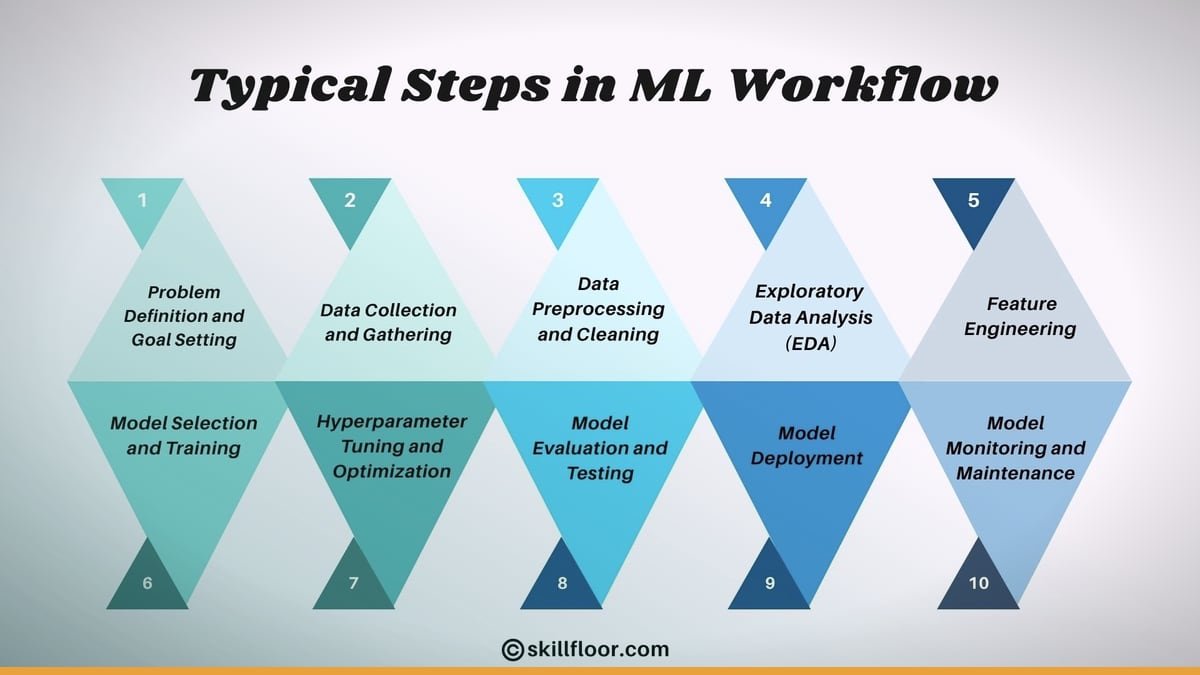
Header image source: Machine Learning Workflow | Process, Steps, and Examples – Skillfloor via Skillfloor via Google — cropped to 16:9 and colour-adjusted.
Key takeaways
- ShowTellArena tests AI comprehension of business workflow rules, exceptions and edge cases
- Most agents fail on boundary and error questions despite claiming workflow awareness
- The benchmark provides auditable, public dataset for comparing enterprise AI products
ShowTellArena has been released. Not another dataset. Not another incremental paper. This is the first standardized protocol to measure whether AI agents actually understand business workflows after watching demonstrations. Fifty workflows—finance, hiring, procurement, customer decisions, inventory, logistics. Each paired with recordings, screenshots, narration. Five hundred two questions designed to expose the gaps in today’s automation hype.
This isn’t about task completion. It’s about comprehension. Rules. Boundaries. Exceptions. Errors. The early results? Most agents fail at the edges.
Workflow Comprehension Is AI’s Blind Spot
AI agents are sold as "workflow-aware. " The reality is messier. Evaluations focus on task completion: can the agent fill out a form, submit a purchase order, generate an offer letter? But understanding why a step exists—or what happens when things go wrong—is a different beast entirely.
Business workflows are riddled with implicit rules. Procurement approvals escalate at certain thresholds. Hiring workflows require compliance checks for certain categories of candidates. These aren’t just steps. They’re conditional logic, exceptions, edge cases. Most AI training data ignores them.
ShowTellArena tests comprehension. Can the agent explain why a field is required? What triggers an escalation? What happens if the system times out? Five hundred two questions target these operational realities. The answers reveal how shallow most workflow AI really is.
ShowTellArena’s Design: Built for Real-World Workflows
The benchmark introduces a "Teach–Comprehend" framework. Two phases:
- Teaching: Agents observe a narrated demonstration—recordings, screenshots, narration—through their own interface. Not a controlled lab. This is how they’d learn in the wild.
- Comprehension: Agents answer 502 questions tied to specific evidence in the demonstration. Not generic queries. Targeted at operational rules ("What triggers an approval escalation? ")Boundaries: Questions about boundaries., exceptions ("How is a damaged shipment handled differently? ")Errors: Questions about errors..
The protocol holds the business scenario and quiz fixed. Each AI product captures the lesson through its own teaching interface. Same workflow, different agents. How well do their architectures extract knowledge from demonstrations?
The v1.0 dataset spans six domains:
- Finance: Various financial workflows.
- Hiring: Various hiring workflows.
- Procurement: Various procurement workflows.
- Customer decisions: Various customer decision workflows.
- Inventory: Various inventory workflows.
- Logistics: Various logistics workflows.
This isn’t a toy dataset. It reflects the nuanced, exception-heavy realities of enterprise operations.
Inside ShowTellArena v1.0
Each of the 50 workflows includes:
- Recordings: Video captures of the workflow in action.
- Screenshots: Key frames annotated with narration.
- Fixture seeds: Pre-configured environments for reproducibility. A procurement system seeded with vendor data or budget thresholds.
- Questions: 502 total, ~10 per workflow, categorized by:
- Operational rules: Questions about operational rules.
- Boundaries: "What’s the maximum discount allowed without approval? "
- Exceptions: Questions about exceptions.
- Errors: "What happens if the vendor’s tax ID is missing? "
The public Hugging Face release (revision e8dc213) includes all 50 workflows. Questions are explicitly linked to evidence in the demonstrations. Traceability matters. Evaluations aren’t black-box outputs. They’re auditable, inspectable assessments.
The dataset is extensible. Researchers can add new workflows or questions while preserving the Teach–Comprehend protocol. This isn’t static. It’s a living benchmark.
Pilot Results: The Sobering Truth About Today’s AI Agents
The paper includes "selected pilot attempts"—no vendor names, but likely early versions of workflow automation products. The results are sobering:
- Rule extraction is brittle. Agents handle straightforward questions ("What’s the next step after submitting a PO? ") but fail on exceptions ("What if the PO exceeds the budget? "). Optimized for "happy path" scenarios. Not the messy realities of business operations.
- Narration matters. Agents relying solely on screenshots perform worse on questions about why a step is taken. They know a manager’s approval is required. They don’t understand it’s because the order exceeds a budget threshold.
- Edge cases are the Achilles’ heel. Questions about errors have the lowest accuracy. Enterprise workflows break at the edges. Agents that can’t handle exceptions are worse than useless.
ShowTellArena isn’t a controlled product ranking. It’s a diagnostic tool. Expose comprehension gaps. Not declare winners. But the implications are clear: most "workflow-aware" AI is advanced macro recording. True comprehension requires deeper integration of business logic. ShowTellArena is the first benchmark to measure it rigorously.
Why This Benchmark Matters for Enterprise AI
The automation paradox: companies deploy AI agents to automate workflows. Without robust comprehension, these agents break on edge cases or require constant human oversight. ShowTellArena exposes this gap.
Compliance risk is real. In finance or hiring, misunderstanding rules leads to costly errors or regulatory violations. An agent that doesn’t understand why a compliance check is required might skip it entirely. ShowTellArena’s questions about boundaries and exceptions target these failure modes.
Then there’s the vendor accountability gap. Most AI workflow tools are evaluated on proprietary, opaque benchmarks. ShowTellArena changes that. Its public dataset and protocol enable:
- Comparable evaluations: Buyers test competing products on the same workflows.
- Auditable claims: Vendors can’t hide behind "black box" performance metrics.
- Iterative improvement: The extensible design lets researchers add new workflows or questions to keep pace with evolving business needs.
The paper states ShowTellArena’s contribution isn’t a product ranking but an "inspectable dataset and assessment workflow that others can extend. " A call to action. Enterprise AI needs benchmarks like this to move beyond marketing hype.
Limitations and Open Questions
ShowTellArena is groundbreaking. It’s not a silver bullet. Clear limitations:
- Fixed scenario constraint. Evaluates comprehension after a demonstration. Real-world workflows often require agents to discover processes on the fly. An agent might need to explore a new CRM to figure out discount approvals. The benchmark doesn’t test adaptive learning.
- Narration dependency. Assumes high-quality narration. In practice, demonstrations might be poorly documented or ambiguous. Agents trained on clear, annotated screenshots might fail in real-world chaos.
- Static dataset problem. Business workflows evolve—new regulations, updated software, shifting policies. The v1.0 dataset might become outdated quickly. The paper acknowledges this but doesn’t propose a solution, like a community-driven update mechanism.
- Missing human-in-the-loop. Tests autonomous comprehension. Many enterprise workflows involve human-AI collaboration. An agent might draft an email for review or escalate a decision to a manager. The benchmark doesn’t address this hybrid mode.
These limitations don’t undermine ShowTellArena’s value. They highlight that workflow comprehension is a multi-dimensional problem. This benchmark is the first rigorous step.
What’s Next? How ShowTellArena Could Reshape Workflow AI
ShowTellArena isn’t just a benchmark. It’s a catalyst.
For researchers:
- New architectures. Could spur development of agents that better integrate narration, screenshots, and business logic. Hybrid vision-language models with explicit rule extraction might improve performance on boundary and exception questions.
- Error recovery. Poor performance on error-related questions suggests a need for agents that anticipate and handle failures. Not just follow happy paths. Breakthroughs in robust, resilient workflow AI could emerge.
For enterprises:
- Procurement criteria. Companies can use ShowTellArena to evaluate AI workflow tools before purchase. Instead of trusting vendor claims, they can test agents on their own workflows. Focus on comprehension, not just task completion.
- Custom benchmarks. Organizations can extend the dataset with their own workflows. Create internal benchmarks for AI readiness. Could become a standard part of enterprise AI adoption.
For vendors:
- Transparency. Products that perform well on ShowTellArena can differentiate themselves. Prove they understand workflows, not just execute them. Could become a key selling point in a crowded market.
- Feature development. The benchmark’s focus on exceptions and boundaries might push vendors to prioritize robustness over speed. Agents that handle edge cases gracefully will stand out.
The authors position ShowTellArena as a starting point. The protocol is designed to be extended. They encourage the community to add new workflows, questions, or evaluation metrics. This isn’t just a benchmark. It’s a foundation for the next era of workflow AI.
The Bigger Picture: Workflow Comprehension Is AI’s Next Frontier
Most AI progress has focused on execution. Can the agent generate code, fill out a form, summarize a document? The next wave requires comprehension. Can the agent explain why a step is necessary? Adapt to exceptions? Handle errors gracefully?
Agents that truly understand workflows can:
- Reduce errors. Catch compliance violations before submission. Flag invalid expenses or missing approvals.
- Enable automation of complex processes. Logistics routing, fraud detection, customer service escalations—all exception-heavy workflows that today’s brittle agents struggle with.
- Improve human-AI collaboration. Explain decisions to auditors. Justify recommendations to managers. Adapt to feedback from human reviewers.
The competitive moat will belong to companies that master workflow comprehension. Today’s rule-based automation tools are limited to simple, repetitive tasks. ShowTellArena proves the gap between marketing hype and real-world reliability is far wider than most realize. The teams that close this gap will define the next era of enterprise automation.
ShowTellArena is a wake-up call. Workflow AI is still in its infancy. The path to reliable, robust automation is longer than most vendors admit. But with this benchmark, we finally have a way to measure progress. And that’s a start.